As a child, L. Francis “Skip” Griffin Jr. remembers his father — the Civil Rights icon Rev. L. Francis Griffin Sr. — inviting community members and fellow activists into their residence on Ely Street.
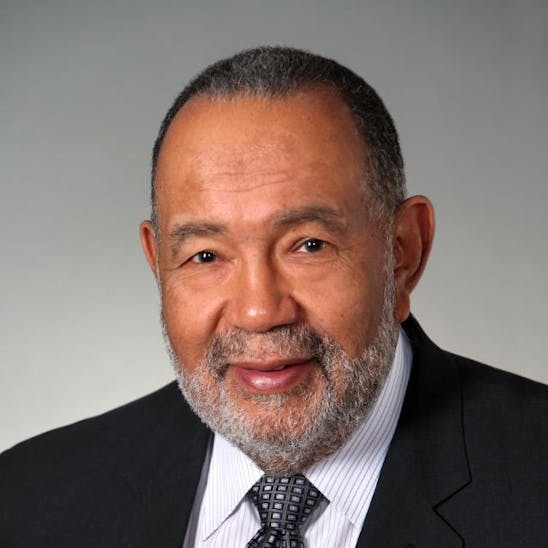
L. Francis "Skip" Griffin Jr. Photo courtesy of Longwood University
“We were in the midst of the [student strike at Moton], and he was very active in civil rights and with the NAACP throughout the state. So, our dinner table was like a classroom, even before the schools closed,” Skip Griffin recalled.
“I was a kid, but I was a little precocious, and my daddy used to let me sit in whenever he was speaking with journalists and listen to everything,” he said. That is the first time he heard the term “eminent domain.”
As reported in February and July 2025 by The Rotunda, Longwood College and state officials used eminent domain or threat of the practice to rapidly expand campus throughout the 20th Century. Eminent domain is the power of state officials to forcefully purchase property it deems as necessary to its operations. Using condemnation proceedings, the legal process behind eminent domain, Longwood was able to force property owners to sell to the college.
In particular, these acquisitions accelerated during the 1950s and 1960s, uprooting a predominantly Black community amid the backdrop of the Civil Rights movement and school closures in Prince Edward County.
Skip Griffin’s family lived in the First Baptist Church parsonage on Ely Street, where the elder Griffin served as pastor. While there, according to Skip, his father was alerted to Longwood’s plan to begin expanding its campus further into the “triangle” of Ely Street, High Street and South Main Street.
“The first person that notified my father that he had seen the plans and he knew this was in the works, was Dean Gordon Moss. He had gotten ahold of the documents, and he was able to show what they were planning to do before they had taken any property,” Skip Griffin said.
Skip Griffin’s father’s legacy and story is foundational in the history of Civil Rights in Virginia. Rev. L. Francis Griffin Sr., after serving in World War II, returned to Farmville to follow in his father’s footsteps as pastor of First Baptist Church. In the face of racism and segregation, Rev. Griffin became a powerful advocate for the Black community and for racial justice, which led him to be dubbed the “fighting preacher.”
A 2004 resolution and commendation in his name approved by the General Assembly referred to Rev. Griffin as “a giant among men and modern social prophet.”
On May 3, 1958, the college officially acquired Rev. Griffin’s parsonage, making it one of the first properties to be taken. The property now serves as the site of Wheeler Hall.
“That was the first cluster of homes to go, and it was very disruptive,” he said. “The neighborhood that you know, all the kids we knew, and they just started buying up home after home, after home.”
“It disrupted a way of life. Even in the face of segregation, there was something comforting about the neighborhood,” Skip Griffin said. He said of the children in the community, “I would say some of the innocence was lost when they took all the properties by eminent domain.”

Longwood University Provost and Vice President for Academic Affairs Dr. Larissa M. Smith, also a civil rights historian and the university liaison to the Moton Museum, told The Rotunda, “While very few of these properties ended up in condemnation proceedings, there was pressure to move and relocate that was short of court proceedings. While landowners were compensated, that money didn't make up the emotional cost.”
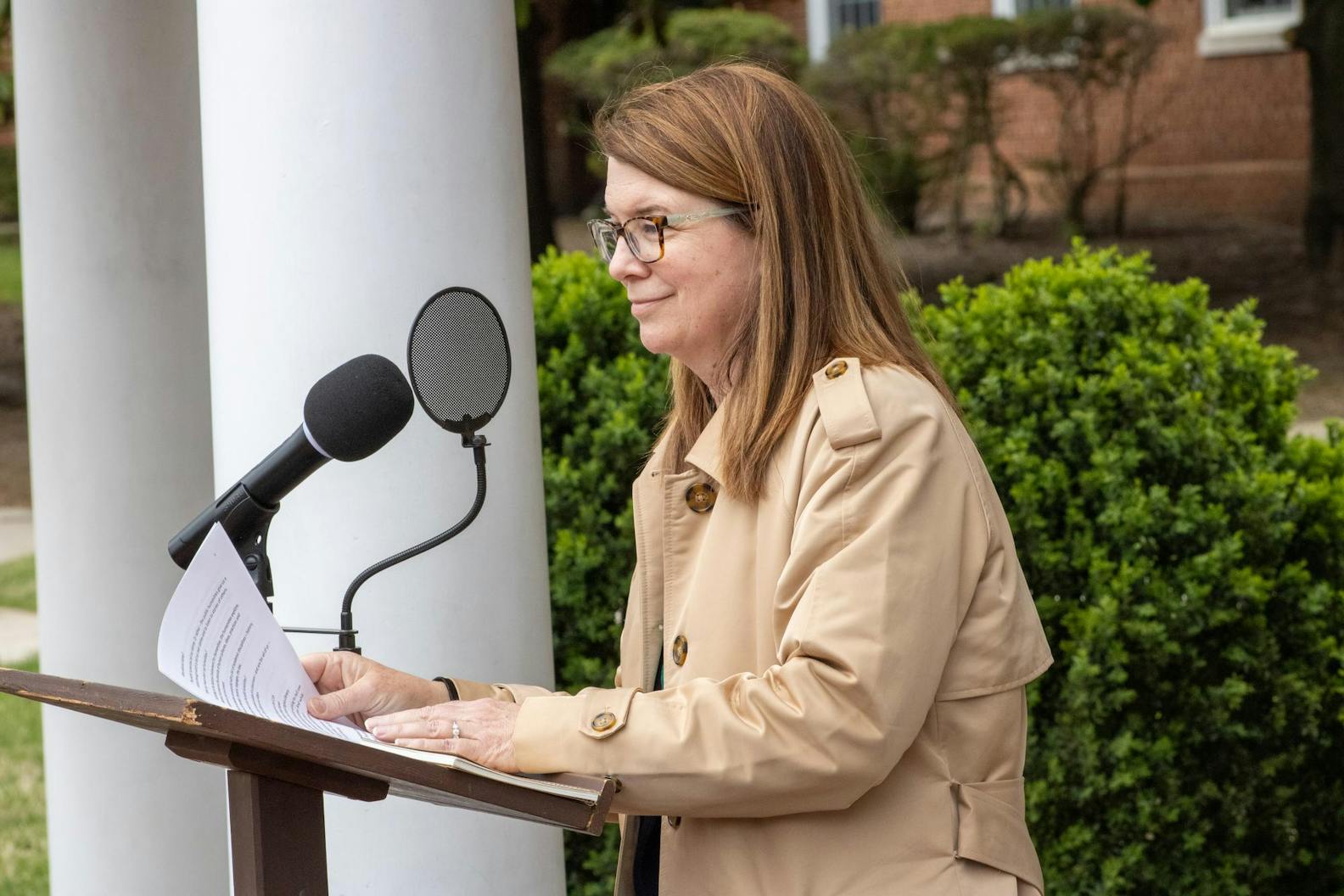
Smith speaks at campus event, April 10, 2025
The college, or the State Board of Education on behalf of the college, used eminent domain 12 times between 1911 and 1990. University officials initially reported 11 acquisitions in a letter to the Commission to Study the History of the Uprooting of Black Communities by Public Institutions of Higher Education, but through research, The Rotunda identified an additional condemnation proceeding that was not previously reported.
In an email statement to The Rotunda, University Spokesperson and Deputy to the President Matt McWilliams said, “Our deed research shows that lot lumped together with the purchase of lot 221107, recorded December 31, 1963.” According to McWilliams, in 1965, university officials realized the separate lot had been deeded to another owner. The property was not occupied, as the relatives of the owner all lived outside of Farmville. The property was then forcefully purchased by the college.
McWilliams wrote, “The university’s research into specific activities and decisions is ongoing, and our response to the Commission represented the most thorough understanding of Longwood’s use of eminent domain at the time it was submitted.”
Longwood’s forceful acquisition of property occurred in the backdrop of the Civil Rights movement. In 1959, just one year after the purchase of the First Baptist Church parsonage, the Prince Edward County Board of Supervisors voted to shut down schools in the county in protest of desegregation.
“It was a double whammy. At first the eminent domain started, and then the schools closed,” Skip Griffin said.
The closure of Prince Edward County schools was a part of a greater effort to maintain racial segregation in Virginia called “Massive Resistance.” This was a plan created by Virginia Senator Harry F. Byrd and his political allies to halt (or “massively resist”) public school desegregation in the wake of the 1954 Brown v. Board of Education decision. Byrd and his allies, called the “Byrd Organization” or “Byrd Machine,” informally ruled Virginia politics for decades in the beginning of the 20th Century.
Based on historical research and interviews with community members, it is likely that some children whose families fell victim to Longwood’s expansion — like Skip Griffin and his siblings — also fell victim to the school closures within the same period of time.
“[The first use of eminent domain] was only about a year before the school closure. So, you couldn't decouple them emotionally. You couldn't decouple the taking of houses by eminent domain from the school closures. That was a big problem,” he said. “And the fact of the matter is that Longwood [was] complicit in the school closing. The faculty and administration didn't have much to say about it, except for Gordon Moss.”
Decades later, in 2014, the Board of Visitors apologized for Longwood’s complicity and said the university “failed to stand up publicly for these ideals, resulting in support to those who opposed desegregation, and falling short in its duty to provide strong moral leadership in the community.”
Smith said, “For a long time here, people didn't acknowledge that. I remember [in 2004] as we're getting ready to commemorate the 50th anniversary of Brown… Someone in Marketing and Public Relations said to me, ‘Well, wasn't Longwood on the fence during the 50s and 60s?’”
“I was like, ‘No, we weren't. We weren't on the fence.’”
Like many Virginia institutions of higher education at the time, Longwood was controlled directly by the State Board of Education. Smith said, “Because of that, [Longwood] was very much tied in with the state's attitude of massive resistance to the Brown [v. Board of Education] decision.”
However, in 1964, the Governor and General Assembly gave control of the college to a newly created and appointed Board of Visitors — ending direct state control of the college and giving the Board the right to expend funds, confer degrees, appoint Presidents and other powers.
In regard to eminent domain, while the college still needed permission from the state to pursue condemnation, Longwood officials could now make more independent decisions about which direction they wanted to expand.
While school closures and direct state control over Longwood had ended, the realities of segregation and eminent domain continued in Farmville. Within the first five years of their existence, the Board of Visitors successfully pursued condemnation for five properties, including the Race Street Baptist Church.
Being a Black community member living in close proximity to Longwood provided a unique set of challenges. “We're right there, adjacent to Longwood is mostly a Black neighborhood, but we were adjacent to this school that was only for white women. It wasn't even co-ed. And so there were, there were laws, [but] then there were customs,” Skip Griffin said.
“You could cut through the college to get downtown, but it probably wasn't a good idea to be a male walking on the college grounds after dark. You could walk through those streets or even cut across the grass. As kids, they wouldn't interfere with you,” he said.
Skip Griffin added, “You were always subject to the fact that somebody would tell you, ‘You don't belong here.’ It was something you learned as a black kid, when it's permissible to walk on [campus]. When people told you, ‘Don't go there,’ you have to take another route. You didn't fight that.”
“Until people got comfortable with Black students and Black people being a part of the Longwood community, you had to explain yourself as to why you were there,” he said.
At the time, while the neighborhoods in the area were not strictly segregated, most of those who lived directly next to the college were Black families. Smith said, “The interesting thing about where people lived in Farmville is that you had this middle-class Black community that was nestled between… where [Longwood College] was and those historically white neighborhoods that expanded in the early 20th century that we call ‘The Avenues’ now.”
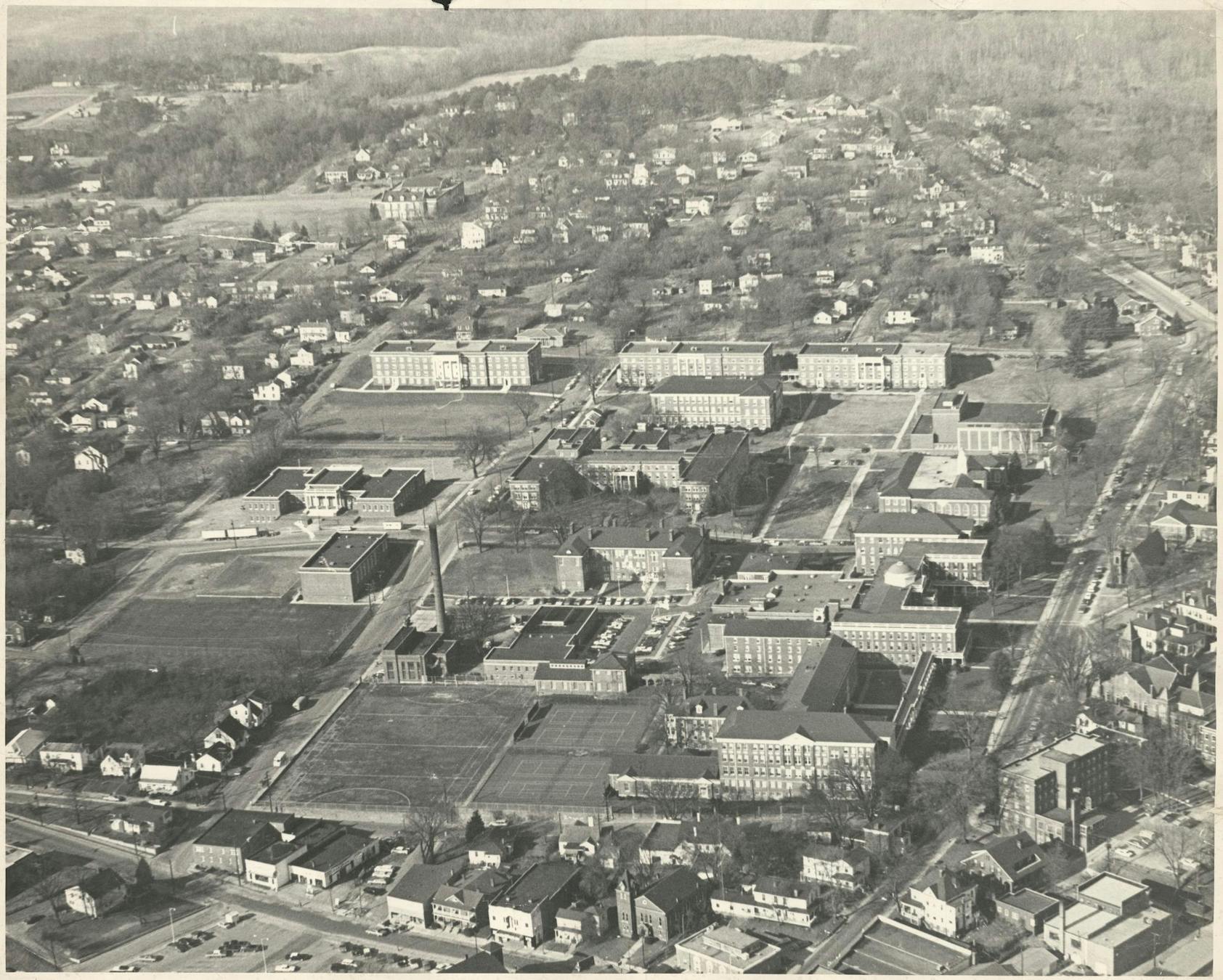
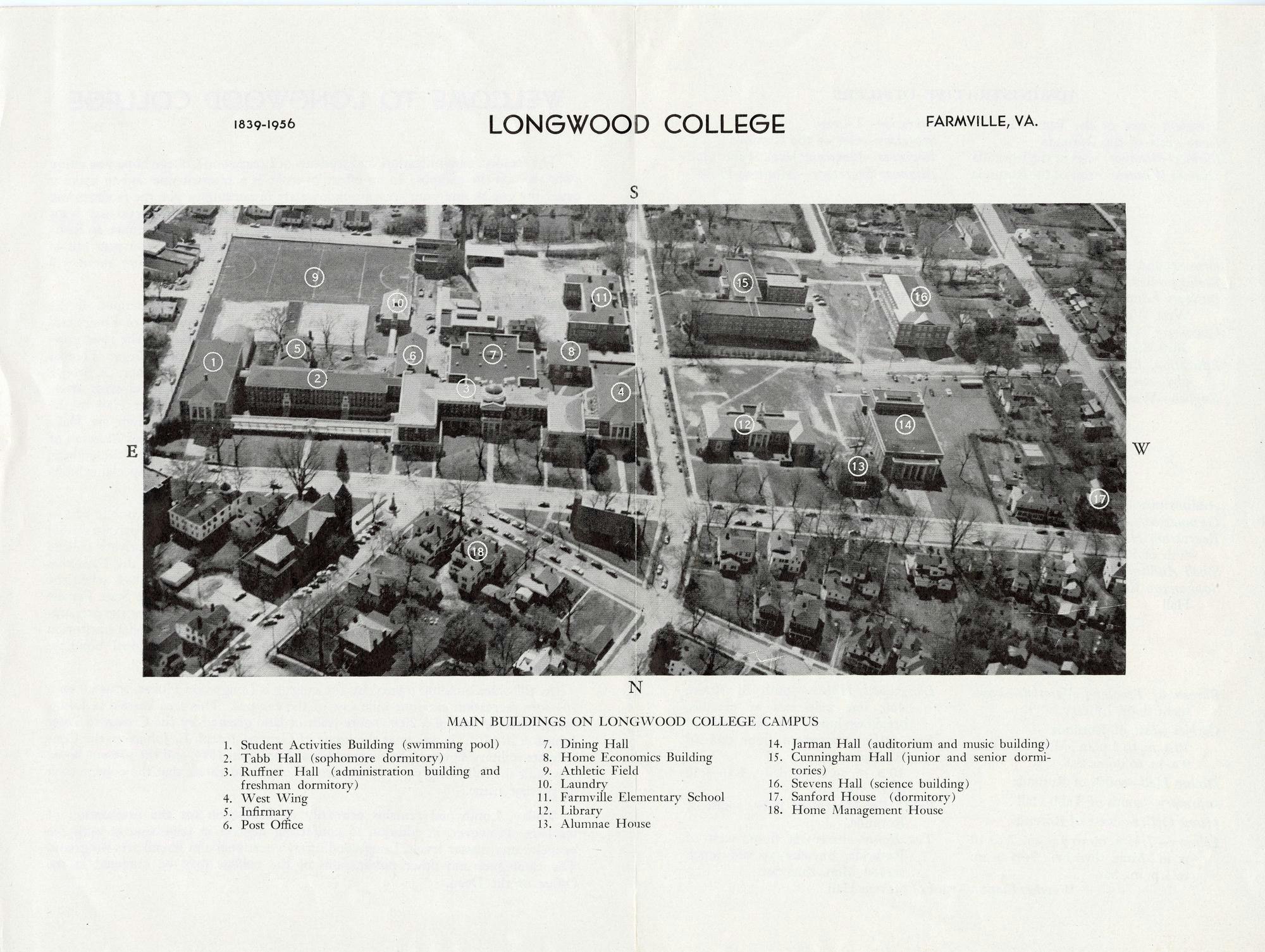
Aerial view of campus and the surrounding community in the late 1960s. Photo courtesy of Krogh.
Skip Griffin said, “Segregation was the law of the state and the law of the region. But, segregation was a funny kind of thing. I found the neighborhood patterns to be more like a checkerboard.”
“We had the houses on [Griffin Boulevard]. You go up to High Street, and the white neighborhood starts,” he added.
This placed the Black community just south of campus, lining Ely Street (now-Griffin Boulevard) and Race, Vine, Franklin and Redford Streets. White community members lived north of campus, as well as on 1st Avenue.
Skip Griffin said that, as officials began to discuss campus expansion, “The feeling [among community members] was that it was much easier to use eminent domain against the Black community than it would have been to use it against the white community.”
“It was probably also less expensive to acquire Black-owned property than to go across High Street… I don't think there was enough land there, but it would have meant buying more expensive property. Race, class and economics all merged into one thing,” he said.
“Now that we have a distance from it, it probably makes logistical sense at the time,” he added. “But I think it did have a racial component. I think they wanted to disrupt [Civil Rights activity], especially since we lived there.”
As Longwood expanded, the predominantly Black middle-class community was squeezed out, forcing them to relocate. While the Griffin family was able to relocate elsewhere in the “triangle,” though Longwood would later purchase that property as well, others had to move further.
“To be Black and to own in that era, it wasn't an easy thing to go and find another property to purchase, because you could only purchase properties in certain neighborhoods,” he said.
“You weren't going to go up on ‘The Avenues,’ you weren't going to go up High Street… You could only purchase properties out in the county or in the areas that were designated as Black neighborhoods.”
Smith echoed this and said, “They were constrained into where they could move because they weren't allowed to move over on First Avenue. They were allowed to work on First Avenue, but they weren't allowed to move over to First Avenue.”
Furthermore, it was incredibly difficult to find builders who were willing to build homes for Black families, or find financing to have a house built. Skip Griffin said, “Even if you were a teacher or you had a small business, they weren't given mortgages. So, it was typically a cash purchase. It was not easy for people to do and then to find somebody to build it.”
As a result, Longwood’s expansion reinforced and worsened pre-existing geographic segregation in the area. Community members in the path of Longwood’s expansion were forced to move elsewhere, either further down Ely Street or out of the neighborhood completely.
In fact, some community members intentionally moved to put themselves out of Longwood’s path. For some, this meant moving from the town’s center entirely. “Several people moved out into the county and built houses out in the county, and a couple of people moved across into Cumberland,” Skip Griffin said.
Much of the de-facto geographic segregation reinforced by Longwood’s expansion still exists today — as communities north and west of campus tend to be predominantly white, and communities south and east of campus tend to be predominantly Black.
While Skip Griffin no longer lives in Farmville, he still remains deeply connected to the community that raised him. He returned to Farmville in 2019 to give the commencement address to undergraduate students.
His speech was given on Wheeler Lawn at the site of the parsonage forcefully acquired for Longwood.
In his speech, Skip Griffin said, “There are some people who say that Longwood has not done enough. I don’t share that opinion. Those were different times.”
Six years later, when asked to reflect on his comments, Skip Griffin said, “I think so. I think Longwood took significant steps to try to rectify the mistakes of the past. Large institutions are, by nature, conservative. They move a little slower than the rest of us.”
However, he did say that further steps could be taken to memorialize the history and give back to the community. He spoke positively about the potential of plaques on campus memorializing various major sites in the neighborhood. In particular, he mentioned the Race Street Baptist Church and the “old playing fields” used by children in the community that now make up the Baseball and Softball fields.
“It was a church with stature and meaning to the community, maybe a plaque saying, ‘This is the site of the Race Street Baptist Church.’ I think that should be done,” he said. “Maybe even where the ball fields are, because most of us learned to play ball on that field, and that's where we spent a lot of time.”
He also mentioned other ways Longwood could give back to the community, such as technology classes for senior citizens.
Smith said that work to memorialize the history and highlight the community is ongoing. “There is an incredibly strong and rich community. We might seem like a small town, but where we are is a big, historic and significant place, when you think of particularly who came out of the black community here,” she said.
She also emphasized community involvement, adding that community input is key in deciding how to memorialize this history. She said, “I really wouldn't want to move forward and decide without having some input from key [community members].” Regardless, she said that this remains a “priority” for her.
Skip Griffin closed his interview by reasserting what he originally said in his commencement speech in 2019, reflecting on Longwood’s progress over the years. He said, “Longwood may not be what she will be, she may not be what she wants to be, but thank God she ain’t what she was.”
This is the third of a series of articles by The Rotunda chronicling the college’s use of eminent domain and its impact on the local community. The Rotunda’s Editorial Board encourages people willing to share their stories or provide information to contact the staff at therotunda@live.longwood.edu.