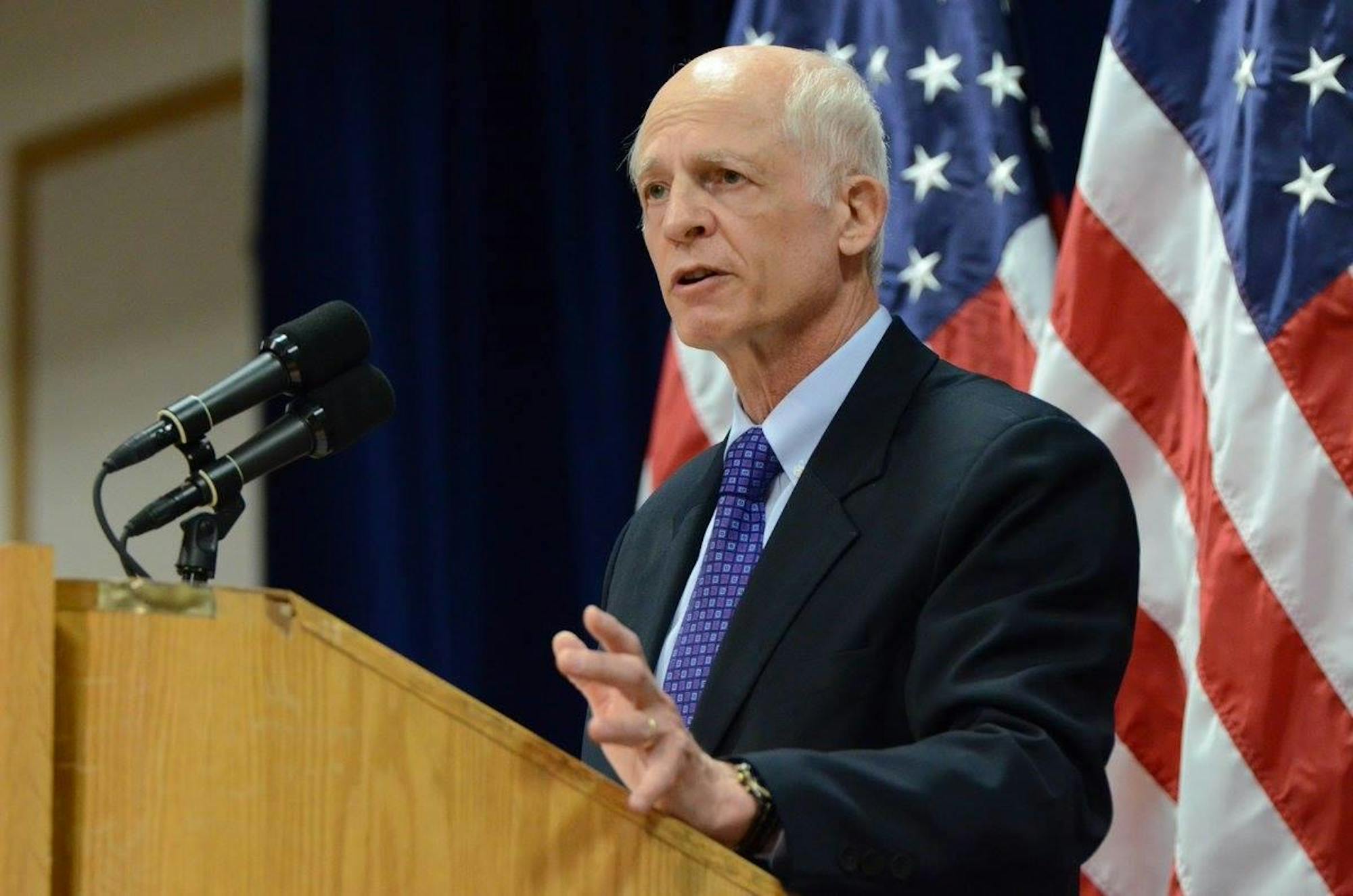
Over the summer, on June 20, 2025, Governor Glenn Youngkin appointed Dr. Michael Poliakoff to the Longwood University Board of Visitors. Poliakoff is one of four new appointees as part of the final round of selections before Youngkin leaves office in January 2026.
Poliakoff enters the board at an unsteady time for the nation’s colleges and universities — particularly in Virginia. Since taking office, President Donald Trump’s administration has used federal funds to public universities to influence policies, curriculum and research at institutions such as the University of Virginia, Harvard University and Columbia University.
Youngkin has sought to make a lasting impact on university boards before leaving office, which is typical of governors of Virginia, as they are limited to only one consecutive term in office. In the past week, the Virginia Supreme Court heard oral arguments regarding the state Senate Privileges and Elections Committee’s vote to block 22 of Youngkin’s appointments, none of which impacted Longwood.
Poliakoff participated in his first meeting on the Board of Visitors on September 12, 2025, and agreed to sit down with The Rotunda for an interview after the meeting.
“I did not question why the Governor and the Secretary of Education wanted me to be here. I'm just proud to be able to serve the people of the Commonwealth, and I will do that with all of my energy and intellect,” Poliakoff said.
Over the years, Poliakoff has worked as a full-time or adjunct faculty member at multiple universities (including at Georgetown University and George Washington University).
He currently serves as the President of the American Council of Trustees and Alumni (ACTA), a conservative-leaning non-profit organization which “works with alumni, donors, trustees, and education leaders across the United States to support liberal arts education, uphold high academic standards, safeguard the free exchange of ideas on campus, and ensure that the next generation receives an intellectually rich, high-quality college education at an affordable price,” according to their website. He has held this role since 2016.
ACTA has been criticized within the past year by organizations such as the American Association of University Professors (AAUP)’s Center for the Defense of Academic Freedom, which has accused ACTA of “engag[ing] in a quiet campaign to subdue faculty authority and shared governance and urge trustees to overpower presidents and faculty governing bodies when conflicts arise.”
ACTA was a part of the Advisory Board for Project 2025, a comprehensive plan put together by the Heritage Foundation to advance conservative ideology in a second Trump Administration.
Poliakoff said he believes the greatest challenge facing Higher Education is “the failure of higher education to deliver a high quality education at an affordable cost… It's both access and excellence. You have to have both of them.”
In particular, he referenced the National Assessment of Adult Literacy (NAAL), a study conducted in 2003 to measure the ability of American adults to understand written or printed information. The study found that millions of adults either lack basic literacy skills or have significant difficulty processing written or printed information.
“The last time it was done was in 2003. They shot the messenger because the message was so terrifying. On average, the average four-year college graduate cannot reliably compare viewpoints in two different newspaper editorials or compute the cost of foods per ounce, or interpret a table on blood pressure,” he said.
“We ask ourselves, ‘What on earth are we doing?’ And we do spend a lot of money in this country on higher education,” he added.

ACTA has placed a focus on these items through initiatives like “How Colleges Spend Money” and “What Will They Learn,” websites allowing viewers to search through available data on financial expenditure, tuition costs and core curriculum requirements.
As he enters his four-year term on the board, Poliakoff said he will take steps to evaluate Longwood’s academic quality. “It starts by listening and asking questions,” he said. “I will be taking a very careful look at academic quality, academic indicators, everything from core curriculum to national norms, test scores, just to get my diagnostics.”
“Certainly, I want to be spending whatever time I can [at Longwood]. This is a bit of a haul from where I live. [It’s about] understanding the campus… ‘What are the student activities? What's the campus climate?’ These are all questions that I really want to ask and explore,” he said.
As part of the Trump Administration’s push to exert influence on institutions of Higher Education, officials have taken aim at Diversity, Equity and Inclusion (DEI) programs. While few changes have been made at Longwood, other schools throughout Virginia have undergone major changes, such as the dissolution of DEI Offices.
Poliakoff is a vocal advocate against DEI programs. “DEI has, unfortunately… rather than a cure for discrimination, it has too often been a vehicle for discrimination,” he said. In particular, Poliakoff said DEI offices have not adequately supported Asian and Jewish students.
“Our objection to DEI has been that it has not, in any way, fulfilled the promises or the expectations that it was supposed to,” he said.
“Every one of those concepts can be a force for good — diversity of experience of the mind,” Poliakoff added. “These are the things that really help people to develop and to learn from one another. And if anything, I think we've been very narrow in our understanding of diversity.”
Poliakoff said, “Some of the things that are assigned to DEI offices are really vital, like the Americans with Disabilities Act (ADA) and veterans, and often they are the least funded part of those offices.”
Poliakoff, reflecting on his appointment, said, “I'm just proud to be able to serve the people of the Commonwealth, and I will do that with all of my energy and what intellect I have to make sure the students at Longwood get the most rigorous, most outstanding education for the lowest possible cost.”
“However I can help lead us to questions about whether we're using our resources to the best possible extent. To the extent that I can help people help us make decisions about what to invest in, perhaps maybe what not to invest in,” he said. “That's really what I want to be able to do.”
The Board of Visitors will next meet from December 4-6, 2025.