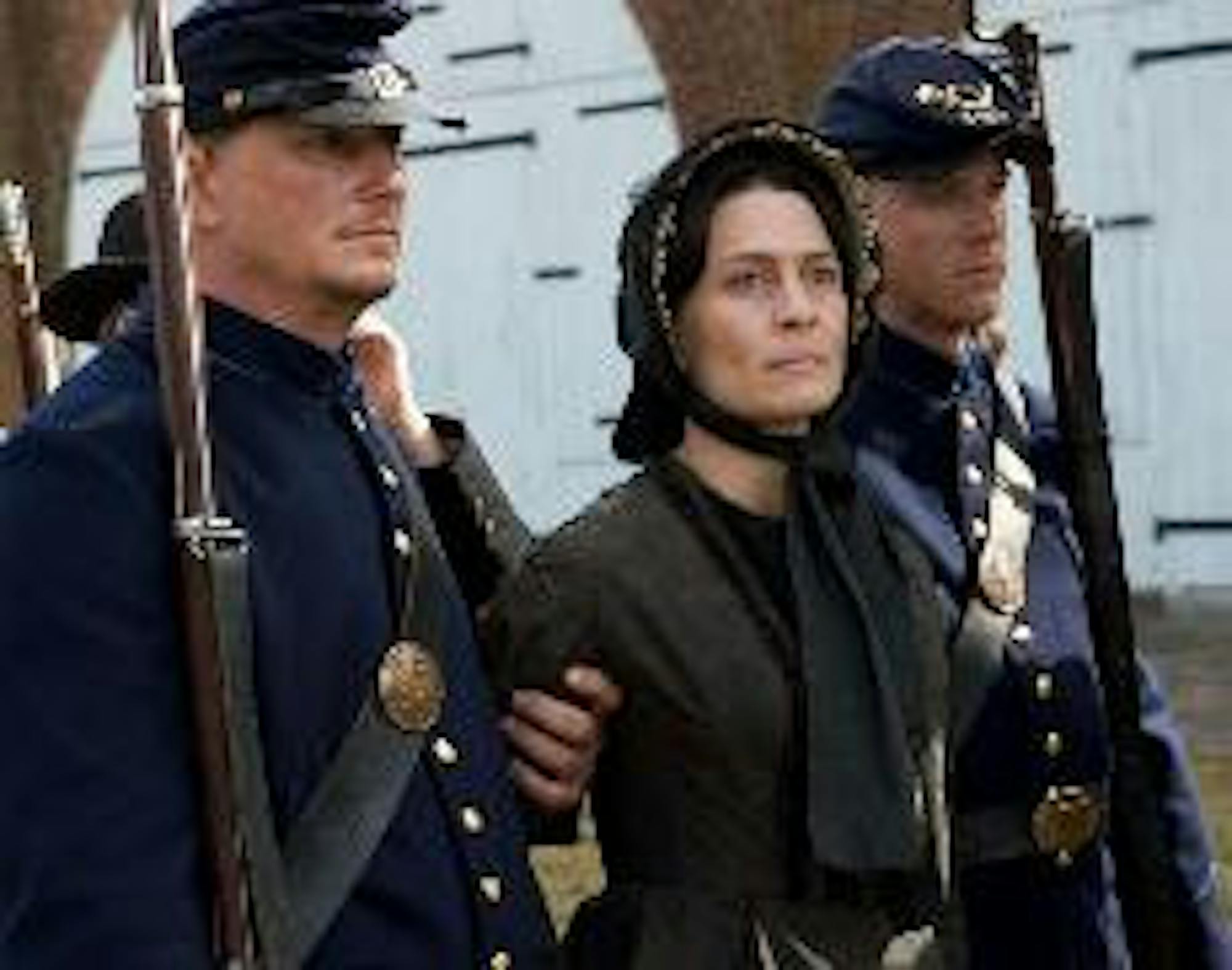
"One bullet killed the President, but not one man." These are the lines that inspired the movie "The Conspirator," written by James D. Solomon and Gregory Bernstein and directed by Robert Redford. The movie starts with a story that is familiar to almost everyone. President Lincoln went to a play that he was never to leave from alive because a young actor, John Wilkes Booth, shot him in the head. His death was one that stirred and shocked a nation, but it was also one that led to an entirely different story that most no one has heard of. The story of Mary Surratt.
The movie took an interesting take of a well-known story and it did so in a fantastically artistic way. Because most of the story takes place in a courtroom, it is the other shots that stand out in importance. A handful of scenes display Mary Surratt, played by Robin Wright, on the floor of a jail cell, a dejected image of her prior self. Others show Frederick Aiken, played by James McAvoy, walking across a bridge to the jail where she is being housed, his demeanor one of contempt but also of compassion.
A particular scene sticks out the most, where Aiken feels the hopelessness of his entire struggle and he walks the streets, half clothed in shadows the other bathed in light. It is a powerful image, and one that Redford, in an exclusive interview, admitted to doing on purpose. "It shows an inner struggle of trying to do the right thing while debating whether or not to give up." It is in these scenes that Redford's artistic side are displayed to the audience. He incorporates the idea of light and darkness throughout the film, using shadow to hide characters faces and light to illuminate them both. This is often seen in the character Anna Surratt, Mary Surratt's young daughter, played by Evan Rachel Wood. Anna Surratt suffers through many internal and emotional struggles, a mess of confusion that is well played by Wood as her struggle burns down to choosing between a brother she loves, or a mother who is in danger.
It is the story of the trial of Mary Surratt and the struggle of young and recently returned home from the war, Frederick Aiken who is chosen to defend her. Aiken refuses, asserting her guilt like the rest of the nation in its grievous state of affairs and the pain all are still experiencing in light of Lincolns recent death. When asked why Redford chose to follow and produce this story he said, "I was attracted to the story. It was one that was unknown and that almost no one knew about. It was a long and rough script, and I knew that Lincoln's story had been well covered over the years, but as I read it, I thought 'This is something different.'" But what the story really burns down to is what is and what is not constitutional, what is wrong and what is right. "What offsets the heavily spoken side of the defense is the defendant. He didn't want the case and thought she was also guilty. He [Aiken] also knew that Mary Surratt wouldn't get a fair trial. I wanted both him and the audience to realize that it wasn't about her [Mary Surratt], it was about the Constitution," said Redford. This is accomplished in the subtle and almost unnoticeable change that overcomes Aiken throughout the film. Instead of letting the prosecution follow through with an injustice, he calls them out, putting his very life into not only defending Mary Surratt, but to defending the very ground that the Constitution is built upon.
Also in the film is famous actress Kevin Kline as Edwin Stanton, the Secretary of War, Danny Huston as Joseph Holt, Justin Long as Nicholas Baker, Aiken's friend, Alexis Bledel as Sarah Weston, Aiken's sweetheart, and Tom Wilkinson as Reverdy Johnson. When asked how Redford went about choosing actors to play characters he responded, "I get really into the casting. Building a relationship between characters is where good casting comes in. You have to have the script pretty solid and then the final step, after knowing the goal, is to have the characters bring their own color to it." And each character did bring their own color to the role they were cast to play. The rocky relationship between Mary Surratt and Aiken was more than believable, it was real, and then the compassion that Aiken later felt for both her and her daughter only further thickened the already livened and complicated plot. Justin Long brought his own sense of humor and comic relief to his character and the script, but also acted as a source of support for Aiken that others did not possess.
The film was a marvel and something different that history had yet to show to the world on the bring screen. Redford claimed that he "wanted to tell the story of my own country," and that is exactly what "The Conspirator" does. It questions the very origins of the country and the Constitution that staples all together, but it also questions human beings, their compassion and their choice between doing what is wrong or fighting for what they believe is right.
"The Conspirator" comes to theaters everywhere on Fri., April 15.