On Friday, Feb. 15, the Longwood Center for the Visual Arts (LCVA) provided a tour of Thornton Dial’s artwork to students. If one was interested in going on the tour, they were to meet in front of Ruffner Hall with students from the Student Diversity and Inclusion Council before proceeding to the LCVA.
Once at the LCVA, the students were whisked away on a tour of Dial’s artwork. Emily Grabiec, the curator of education at the LCVA, stated that the Thornton Dial exhibition is a fall exhibition that has continued this spring.
She further commented that Dial is a self-taught artist based out of Alabama.
Dial experienced poverty growing up and stopped attending school after the third grade to help his family by working on a sharecropper farm. In his adult life, Dial worked numerous jobs, including on mills, factories and more. Some of that experience he put into his art. In several of Dial’s paintings and creations, he uses ties.
“You see a lot of different themes in his artwork,” said Grabiec. “He [Dial] deals a lot with race. Race is a really big theme in his art, so I think it’s things that he experienced growing up. You also see a lot of things as far as what he did for work.”
One of Dial’s creations was just that. It looked as if the people in the artwork were actually farming and working in the field. Other symbols Dial uses throughout his art included a tiger and birds of various natures.
Grabiec said, “Tigers are something he uses a lot to symbolize his identity as being African- American, and then he also uses them a lot in paintings where he’s trying to look at his desire for racial equality. “
She further commented, “Like how we saw [with] the blue jeans, he commonly uses ties in his paintings and that is often to symbolize wealth or he uses a lot of times to [point out social divides]. I think that’s what’s going to be really powerful and interesting about his artwork is kind of the symbols that he puts in there.”
After a while of being introduced to Mr. Dial, the students on the tour got to view a brief video on Thornton Dial, and in the video, he talks about his use of ties in his paintings. When he would work at the mills and the factories, he would see white men going to work dressed up and wearing ties. But he couldn’t wear a tie to work because of the rather dangerous nature of his job.
Dial repeatedly used what he had on hand to create his artwork and still does to this day. His canvas? Pieces of wood. He used a piece of a sprinkler to use as a person’s head in another one of his pieces. Once he found an old car in a ditch and brought it back to his home. He then took it completely apart and turned it into 11 different pieces of art. These art pieces are not part of the collection at the LCVA.
The Thornton Dial exhibit will be up for another month before the LCVA starts showcasing their spring exhibit of the works of the Longwood University seniors.
The Longwood Center for the Visual Arts is located at 129 N. Main Street. The LCVA is open from 11 a.m. to 5 p.m. from Monday to Saturday.
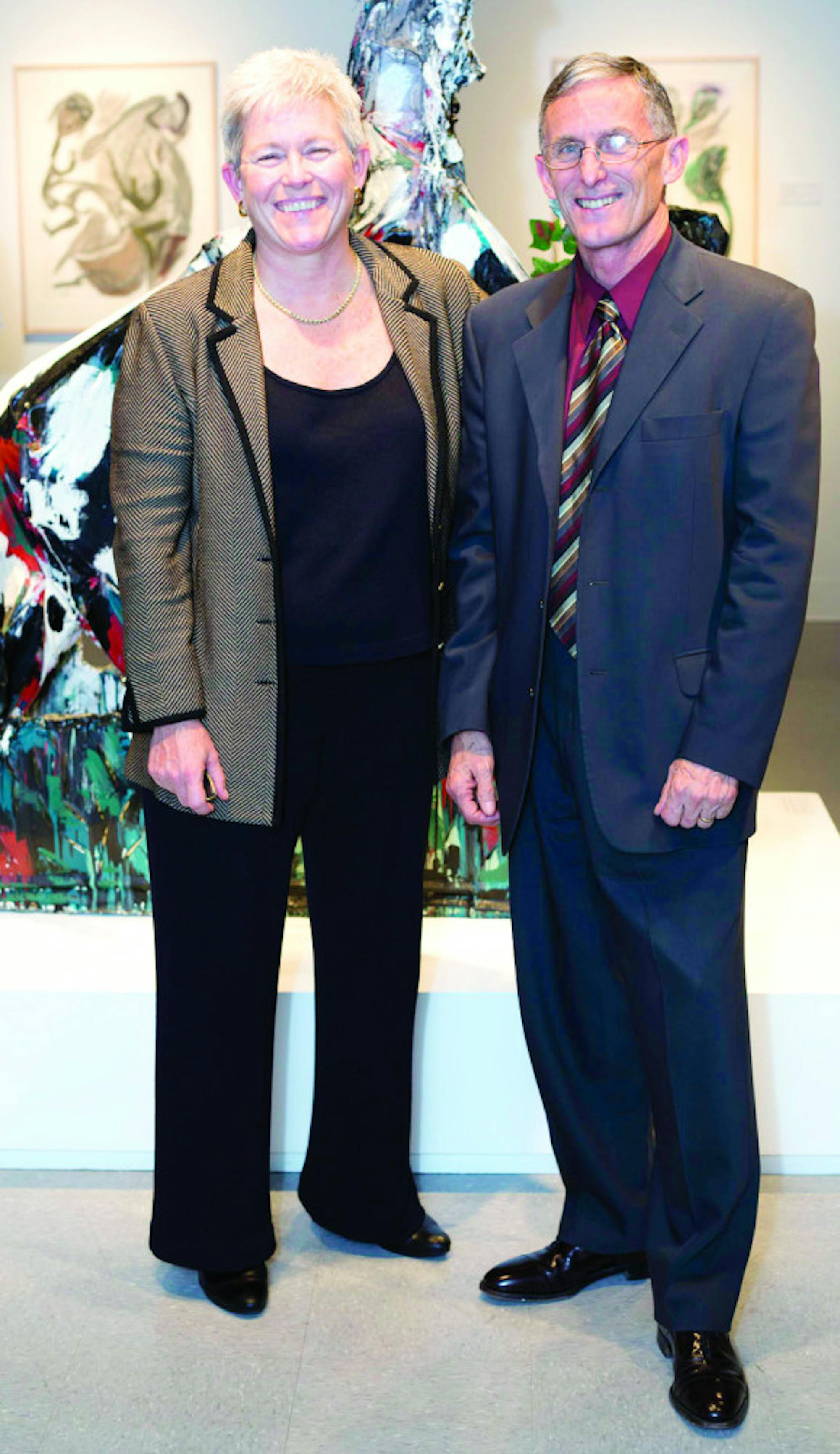
Interm President, Marge Conelly, and Dr.Wayne McWee, chair of the Art Department, pose for a photo at the Thorton Dial Opening December 7,2012.